Brother Ray by David Ritz
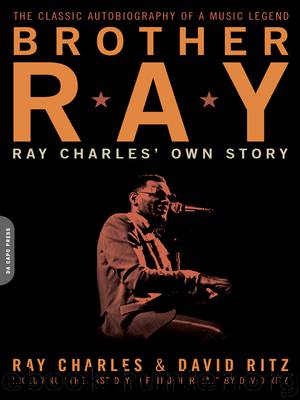
Author:David Ritz [RAY CHARLES AND DAVID RITZ]
Language: eng
Format: epub
Publisher: Da Capo Press
Published: 2012-01-27T05:00:00+00:00
Widening
the Range
I mentioned to you that by 1959 I was ready to put the era of dances behind me. Some of my nasty experiences had given me the nerve to tell the Shaw Agency that I wouldn’t play gigs like that anymore. Now I was banking on my ability to get decent concert jobs and nightclub engagements.
I no longer wanted to take the chance of getting clubbed or shot I didn’t need that kind of shit. Now, more than ever, I was interested in protecting me. I figured the Lord had been good to me so far and maybe I should quit while I was one step ahead.
Self-preservation wasn’t the only reason, though, that I quit playing dance halls. I also felt it was having a bad effect on my music. I often wouldn’t play my trio numbers at those places because the pianos were so pathetic. I’ve seen some incredible instruments, pianos so shoddy and flat that I had to play C-sharp instead of C to be in the same key as the band.
Actually, that’s how I learned to play in all keys. I was forced to in order to match the band, But even that might not do the trick. Two or three keys in the middle of the piano wouldn’t work at all, or would keep ringing after you’d strike ‘em.
Some promoters just didn’t give a shit. They stuck your name outside and hoped that the bodies would flow in. Others took the time to make sure your playing conditions were decent.
It’s not just the ratty dance halls that have bad conditions. Even in the so-called fancy supper clubs I’ve seen dressing rooms so filthy that you wouldn’t let a dog use ‘em. I can’t stand my own filth, much less anyone else’s. (I remember playing a high-class club in New York once where the facilities for the artists were so dirty that I had to rent a hotel room next door for me to change my clothes.)
But at age twenty-eight I was still innocent enough to think that conditions were really going to get better. I wanted to upgrade my act. My money wasn’t as funny as it had been. In 1954 I might have been making $200 or $250 a job; by ‘58 or ‘59 that had increased to $500 or $600, and a good night brought $800.
Newport and Carnegie Hall became early proof that I could reach different audiences in different arenas. I saw that as a compliment and a challenge, though I wasn’t that overwhelmed by the experiences themselves.
I’ve always played to people, not to places. Maybe that’s because I can’t physically see those places. I’m not certain. Either way, I’ve never been impressed by the idea of performing in a club or a concert hall with a fancy-sounding name. After Carnegie Hall, I’ve been more or less nonchalant about all the others.
Earlier I was telling you how I never test songs on the public before I record them. I’ve always been my own private testing service.
Download
This site does not store any files on its server. We only index and link to content provided by other sites. Please contact the content providers to delete copyright contents if any and email us, we'll remove relevant links or contents immediately.
The Goal (Off-Campus #4) by Elle Kennedy(13624)
Kathy Andrews Collection by Kathy Andrews(11774)
Diary of a Player by Brad Paisley(7530)
What Does This Button Do? by Bruce Dickinson(6176)
Assassin’s Fate by Robin Hobb(6173)
Big Little Lies by Liane Moriarty(5759)
Altered Sensations by David Pantalony(5079)
Pale Blue Dot by Carl Sagan(4967)
Sticky Fingers by Joe Hagan(4155)
The Death of the Heart by Elizabeth Bowen(3588)
The Heroin Diaries by Nikki Sixx(3525)
Beneath These Shadows by Meghan March(3284)
Confessions of a Video Vixen by Karrine Steffans(3282)
How Music Works by David Byrne(3239)
The Help by Kathryn Stockett(3127)
Jam by Jam (epub)(3059)
Harry Potter 4 - Harry Potter and The Goblet of Fire by J.K.Rowling(3038)
Computational Linguistics and Intelligent Text Processing: 20th International Conference, CICLing 2019 La Rochelle, France, April 7â13, 2019 Revised Selected Papers, Part I by Alexander Gelbukh(2968)
Strange Fascination: David Bowie: The Definitive Story by David Buckley(2842)
